Canadian businesses face threats from both the physical and digital worlds. A stolen access badge, a forced entry, a phishing email, and an unpatched cloud application can all disrupt operations, expose sensitive information, and damage customer trust.
A modern security planning process brings physical security and cybersecurity together in one coordinated strategy. It protects offices, warehouses, retail locations, production facilities, employees, inventory, data, cloud applications, and endpoint devices.
A well-designed security plan for business operations helps organizations:
- Reduce the likelihood and impact of security incidents.
- Protect employees, customers, facilities, and digital assets.
- Maintain business continuity during unexpected disruptions.
- Support privacy, regulatory, and contractual obligations.
- Demonstrate responsible risk management to insurers, partners, and customers.
Security planning is not a one-time exercise. It is a continuous process that must evolve as the business adds employees, adopts new technology, changes locations, or faces new threats.
What Are the Essential Steps for Developing a Business Security Strategy?
A comprehensive business security strategy should follow a structured lifecycle. The exact controls will vary by organization, but most effective plans include five core stages.
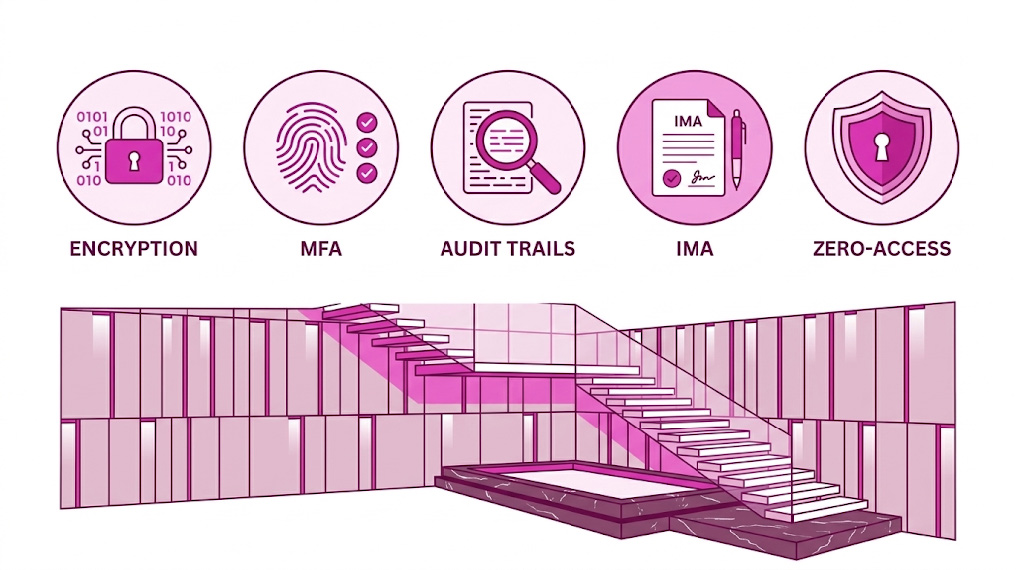
1. Create an Asset Inventory
Begin by identifying everything the organization needs to protect. This includes both physical and digital assets.
Physical assets may include:
- Offices and commercial buildings.
- Warehouses, production areas, and server rooms.
- Vehicles, equipment, and inventory.
- Access cards, keys, and security devices.
- Utilities and environmental systems.
Digital assets may include:
- Customer and employee information.
- Financial and payment systems.
- Business applications and SaaS platforms.
- Cloud storage and databases.
- Company websites and domains.
- Laptops, mobile devices, and servers.
- Proprietary software, intellectual property, and source code.
Classify each asset according to its importance, sensitivity, and business impact. For example, a public marketing website and a payroll database should not receive the same level of protection.
2. Perform a Risk Assessment
A risk assessment identifies what could go wrong, how likely an event is to occur, and how seriously it could affect the business.
Potential threats may include:
- Forced entry or unauthorized facility access.
- Internal theft or misuse of company resources.
- Fire, flooding, or equipment failure.
- Phishing, ransomware, and credential theft.
- Data loss or accidental disclosure.
- Supply-chain and third-party compromises.
- Cloud misconfigurations.
- Website defacement or denial-of-service attacks.
Businesses should evaluate both financial and operational impact. A low-probability event may still require attention if it could stop production, expose regulated information, or create significant legal liability.
3. Establish Policies and Governance
Policies turn security expectations into consistent business practices. They should clearly define who is responsible for approving access, responding to incidents, reviewing alerts, and updating security controls.
Important policies may cover:
- Physical access and visitor management.
- Acceptable use of company devices.
- Passwords and multi-factor authentication.
- Employee onboarding and offboarding.
- Data retention and secure disposal.
- Remote work and mobile device use.
- Vendor and third-party access.
- Incident response and breach notification.
- Backup, recovery, and business continuity.
Governance also means assigning owners to each major risk. A security plan is less effective when every responsibility is described as “the IT department’s job” without a named owner or review date.
4. Implement Layered Controls
Layered security combines multiple safeguards so that one failed control does not expose the entire business.
A layered approach may include:
- Perimeter barriers and controlled entry points.
- Commercial access control systems.
- Business security systems with cameras.
- Monitored intrusion and business alarm systems.
- Network segmentation and next-generation firewalls.
- Multi-factor authentication and identity controls.
- Endpoint detection and response.
- Secure cloud configurations.
- Employee security awareness training.
- Tested and isolated backups.
The objective is not to purchase the largest number of tools. It is to build a practical system in which each control supports the others.
5. Test and Improve the Plan
Security controls must be tested regularly. A camera that is pointed at the wrong area, an alarm that nobody monitors, or a backup that cannot be restored creates a false sense of protection.
Testing may include:
- Physical security walkthroughs.
- Access badge and visitor reviews.
- Camera coverage and recording checks.
- Alarm response exercises.
- Vulnerability scans and penetration testing.
- Phishing simulations.
- Incident response tabletop exercises.
- Backup restoration tests.
- Employee access reviews.
- Vendor and third-party assessments.
Review the security plan at least annually and after major changes such as a relocation, acquisition, new cloud deployment, remote-work expansion, or significant security incident.
What Are the Essential Components of a Modern Business Security Plan?
A modern security plan for business operations should integrate physical protection, cybersecurity, governance, and business continuity. Treating these areas as separate programs can create gaps between facility security, IT, operations, and leadership.
Physical Security Infrastructure
Physical security protects employees, facilities, equipment, inventory, and on-site technology.
Commercial Access Control Systems
Commercial access control replaces traditional keys with controlled credentials such as:
- Encrypted access cards.
- Key fobs.
- Mobile credentials.
- Biometric authentication.
- PIN-based entry.
- Visitor management systems.
An effective access control system should record entry events, restrict access by role or schedule, and allow administrators to revoke credentials quickly when an employee leaves the company.
Businesses should also review tailgating risks, shared credentials, inactive badges, and access to sensitive spaces such as server rooms, stockrooms, and financial offices.
Business Security Systems With Cameras
Business security camera systems provide visibility across entrances, exits, parking areas, loading docks, inventory spaces, and restricted areas.
Modern IP camera systems may include:
- High-definition video.
- Remote monitoring.
- Motion detection.
- Video analytics.
- Line-crossing alerts.
- People and vehicle detection.
- Low-light and infrared recording.
- Cloud or on-premises storage.
- Integration with access control and alarm systems.
Camera placement should be based on a documented risk assessment. More cameras do not automatically create better security if important entrances, blind spots, or recording limitations are ignored.
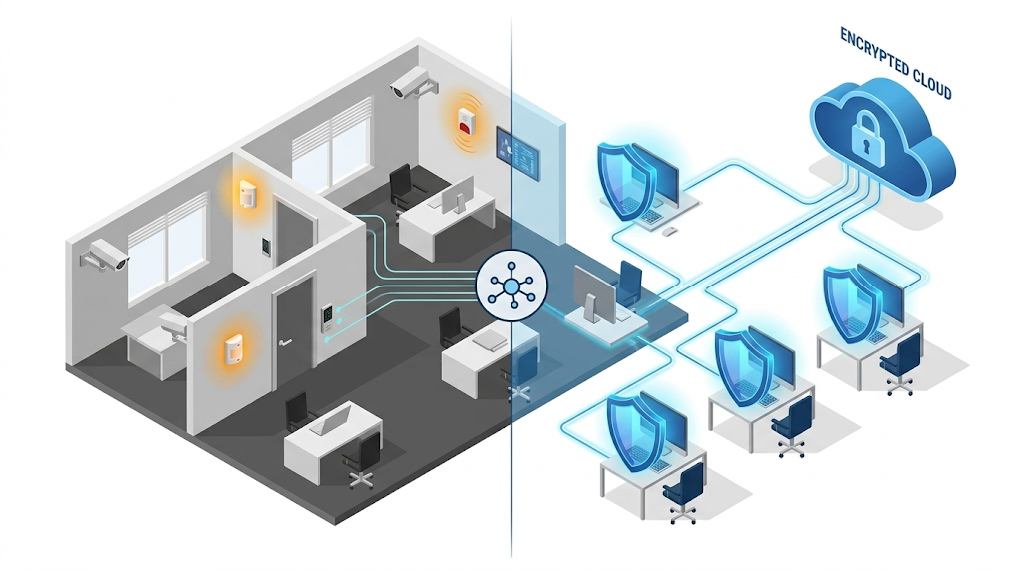
Intrusion and Business Alarm Systems
Business alarm systems can detect:
- Door and window openings.
- Glass breakage.
- Motion.
- Duress or panic events.
- Smoke, heat, and water leaks.
- Equipment or temperature failures.
Monitored alarms typically send signals to a central monitoring station. Depending on the event and local requirements, the monitoring provider may verify the alarm before contacting emergency services.
Businesses should confirm:
- Who receives alarm notifications.
- How events are verified.
- What happens if the internet or power fails.
- Whether backup communications are available.
- Whether local false-alarm rules apply.
- How often sensors and batteries are tested.
Digital and Cybersecurity Architecture
Cybersecurity for small businesses should focus on the controls that reduce the most common and damaging risks. The same principles apply to larger organizations, although enterprises often require more complex tools and dedicated security teams.
Next-Generation Firewalls
Next-generation firewalls inspect and control network traffic using more than basic IP addresses and ports. Depending on the product and configuration, they may provide:
- Application awareness.
- User and identity integration.
- Intrusion prevention.
- Web filtering.
- Malware protection.
- Virtual private networking.
- Traffic inspection.
- Network segmentation.
- Logging and alerting.
Firewall deployment should be paired with secure configuration, regular rule reviews, timely updates, and monitoring. A powerful firewall with outdated rules can still leave a business exposed.
Cloud Security and Storage Protections
Cloud services introduce risks related to misconfigured storage, excessive permissions, exposed credentials, and third-party access.
A cloud security plan may include:
- Multi-factor authentication for administrators.
- Least-privilege access.
- Encryption in transit and at rest.
- Secure backup policies.
- Cloud configuration monitoring.
- Logging and alerting.
- SaaS account reviews.
- Data loss prevention.
- Vendor security assessments.
Cloud providers remain responsible for securing the underlying infrastructure, while the customer is generally responsible for configuring and using the service securely. This shared-responsibility model makes configuration reviews essential.
Endpoint Detection and Response
Endpoint Detection and Response, or EDR, monitors workstations, servers, and other devices for suspicious behaviour.
EDR may identify:
- Unusual process execution.
- Suspicious scripts.
- Credential access attempts.
- Registry or configuration changes.
- Lateral movement.
- Malicious file activity.
- Unexpected outbound connections.
EDR is most effective when alerts are reviewed and acted upon. Small businesses without internal security staff may use Managed Detection and Response, or MDR, to obtain monitoring and investigation from an external security operations team.
Governance and Risk Mitigation
The governance layer defines how security decisions are made and measured.
| Component | Primary function | Operational impact |
| Security frameworks | Establish recognized security and privacy baselines | Supports audits, customer reviews, and risk prioritization |
| Risk register | Records threats, owners, scores, and treatment decisions | Keeps security work organized and accountable |
| Cyber insurance | Helps transfer certain financial risks associated with incidents | May support recovery, legal, notification, and business interruption costs |
| Vendor due diligence | Evaluates security providers and third parties | Reduces exposure from suppliers and contractors |
| Business continuity planning | Defines how critical operations will continue | Reduces downtime during security or infrastructure failures |
A security business licence or contractor credential may also be relevant when selecting a physical security provider. Requirements vary by province and by the type of work being performed, so businesses should verify the applicable rules in their jurisdiction.
Which Security Assessment Frameworks Fit Canadian SMBs?
Small and medium-sized businesses in Canada can use established frameworks to organize their cybersecurity and risk management activities.
Canadian Centre for Cyber Security Baseline Controls
The Baseline Cyber Security Controls for Small and Medium Organizations provides practical guidance for Canadian SMBs. It covers 13 control areas and is designed to help organizations prioritize high-value safeguards without building an unnecessarily complex program.
The baseline can help businesses structure activities related to:
- Asset management.
- Access control.
- Authentication.
- Data protection.
- Backup and recovery.
- Employee awareness.
- Incident response.
- Security updates.
- Network protection.
The framework is recommended guidance for most private-sector organizations rather than a universal legal requirement. It can also support organizations pursuing CyberSecure Canada certification.
CIS Critical Security Controls v8.1
The CIS Critical Security Controls provide a prioritized approach to cybersecurity. Version 8.1 contains 18 controls and 153 safeguards organized into three Implementation Groups:
- IG1: Essential cyber hygiene for organizations with limited resources.
- IG2: Additional safeguards for organizations with more complex environments.
- IG3: Advanced protections for organizations with significant risk or regulatory obligations.
Many small businesses can begin with IG1 and expand their controls as their technology, workforce, and risk profile grow.
NIST Cybersecurity Framework 2.0
The NIST Cybersecurity Framework 2.0 organizes cybersecurity activities into six functions:
- Govern.
- Identify.
- Protect.
- Detect.
- Respond.
- Recover.
The Govern function emphasizes leadership, organizational context, cybersecurity strategy, policy, and supply-chain risk. This makes the framework useful for businesses that need to connect cybersecurity decisions with financial, operational, and compliance priorities.
Businesses do not have to choose only one framework. For example, an organization may use the Canadian baseline for practical implementation, CIS Controls for technical prioritization, and NIST CSF 2.0 for leadership reporting.
What Is the Best Security Planning Software for Small Businesses in Canada?
The best security planning software depends on the organization’s size, compliance goals, technical environment, and internal resources. No single platform is the best choice for every business.
Compliance Automation Platforms
Platforms such as Vanta, Drata, and Secureframe can help organizations:
- Collect evidence.
- Assign control owners.
- Track remediation tasks.
- Monitor control changes.
- Manage policy acknowledgements.
- Prepare for SOC 2 or ISO 27001 assessments.
- Map controls to multiple compliance requirements.
These platforms are most useful when a business has recurring audit requirements or needs to demonstrate security maturity to customers and partners.
Risk Register and GRC Tools
Governance, risk, and compliance tools help businesses document:
- Identified threats.
- Risk likelihood and impact.
- Control effectiveness.
- Risk owners.
- Treatment plans.
- Review dates.
- Exceptions and accepted risks.
A simple risk register may be sufficient for a small business. More complex organizations may need a dedicated GRC platform with workflows, approvals, reporting, and audit trails.
Security Awareness and Policy Tools
Security awareness platforms can provide:
- Phishing simulations.
- Employee training.
- Policy distribution.
- Policy acknowledgement tracking.
- Security quizzes.
- Reporting dashboards.
Tools such as KnowBe4 and Hoxhunt are examples of platforms used for security awareness and phishing resilience. The appropriate choice depends on budget, workforce size, language requirements, reporting needs, and integration options.
Physical Security Planning
Compliance software does not replace a physical security assessment. Businesses should separately document:
- Camera locations and blind spots.
- Access zones.
- Alarm sensor coverage.
- Visitor procedures.
- Key and badge management.
- Emergency exits.
- Lighting and perimeter risks.
- Monitoring and escalation procedures.
The results can then be linked to the organization’s broader security plan.
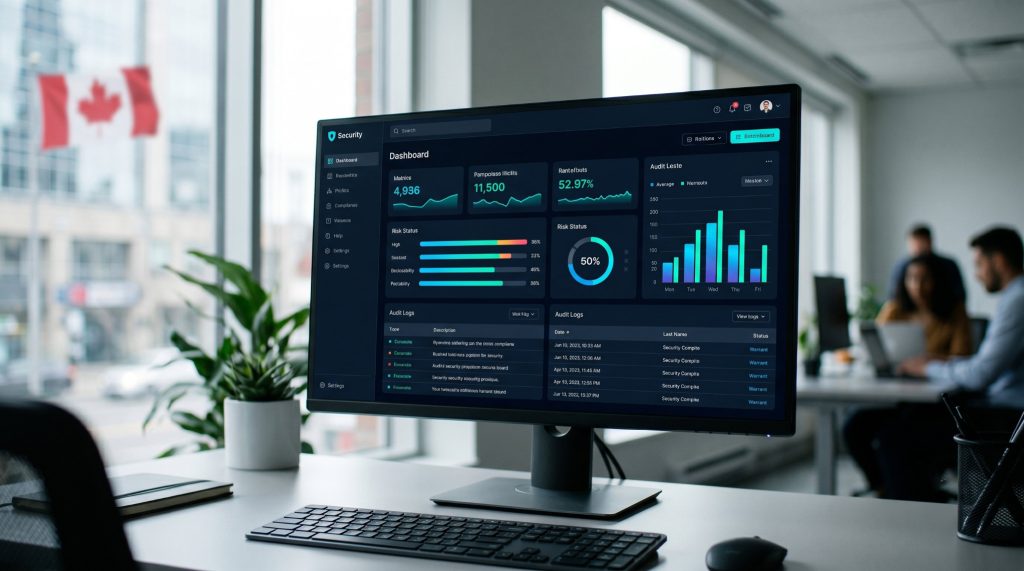
How Do EDR, MDR, and XDR Solutions Compare?
Endpoint security solutions differ in the technology they monitor and who is responsible for responding to alerts.
EDR: Endpoint Detection and Response
EDR collects behavioural information from endpoints and helps security teams investigate suspicious activity.
EDR is generally suitable for organizations that have:
- Internal IT or security staff.
- A defined incident response process.
- Someone available to review alerts.
- The capacity to isolate devices and investigate incidents.
The business controls the platform, but it is also responsible for monitoring and response.
MDR: Managed Detection and Response
MDR combines security technology with external monitoring and investigation. A provider’s security operations centre may:
- Review alerts.
- Investigate suspicious activity.
- Isolate compromised devices.
- Escalate serious incidents.
- Support containment and remediation.
- Provide reports and recommendations.
MDR can be a practical option for Canadian SMBs that lack 24/7 security coverage.
XDR: Extended Detection and Response
XDR connects signals from multiple security domains, such as:
- Endpoints.
- Email.
- Cloud workloads.
- Identity systems.
- Network infrastructure.
- Firewalls.
- SaaS applications.
By correlating these signals, XDR can provide more context about an attack that moves between email, identity, endpoint, and cloud systems.
| Factor | EDR | MDR | XDR |
| Primary scope | Endpoints | Managed monitoring of endpoints and other sources | Multiple security domains |
| Who responds | Internal team | Provider’s security operations team | Internal team or provider, depending on deployment |
| Best fit | Businesses with security staff | Businesses without 24/7 monitoring | Organizations with mature, integrated environments |
| Main advantage | Detailed endpoint visibility | Access to specialist monitoring | Cross-domain attack correlation |
| Main limitation | Alerts require internal action | Requires provider trust and coordination | More complex and dependent on integrated data sources |
What Are the Top Cloud Security Solutions for Canadian Businesses?
Cloud security solutions protect cloud storage, virtual infrastructure, SaaS applications, identities, and data flows.
Cloud Access Security Brokers
Cloud Access Security Brokers, or CASBs, help organizations monitor and control the use of cloud services. They may provide:
- Shadow IT discovery.
- Access policy enforcement.
- Data loss prevention.
- Malware detection.
- User and entity behaviour analysis.
- Cloud application risk assessments.
Microsoft Defender for Cloud Apps and Netskope are examples of products in this category.
Cloud Security Posture Management
Cloud Security Posture Management, or CSPM, reviews cloud environments for configuration weaknesses and compliance gaps.
CSPM tools may detect:
- Publicly exposed storage.
- Excessive permissions.
- Unencrypted resources.
- Open network ports.
- Missing logging.
- Weak identity configurations.
- Infrastructure compliance issues.
Products such as Wiz and Palo Alto Prisma Cloud support cloud security posture management across major cloud environments.
Canadian Data Residency Considerations
Canadian data residency requirements depend on the organization, industry, contract, province, and type of information being handled.
PIPEDA does not generally require all personal information to remain physically in Canada. However, organizations remain responsible for protecting personal information when it is transferred to a third party or processed outside the country.
Some businesses choose Canadian cloud regions as a risk-reduction or contractual measure. Public-sector, healthcare, and regulated customers may also impose specific data-location requirements.
Before selecting a cloud region, review:
- Applicable privacy legislation.
- Customer and supplier contracts.
- Industry-specific obligations.
- Cross-border access arrangements.
- Encryption and key-management requirements.
- Cloud provider terms and support access.
Why Is Risk Management Important for Long-Term Business Survival?
Risk management helps business leaders decide which threats require immediate action and which can be monitored or accepted. It connects security spending to business priorities rather than treating every vulnerability as equally urgent.
A structured risk management process can help organizations:
- Prioritize security investments.
- Reduce avoidable downtime.
- Clarify accountability.
- Prepare for insurance and customer reviews.
- Improve incident response.
- Protect revenue and reputation.
- Support business continuity.
The Cost of Security Failures
A security incident can create several types of loss at the same time.
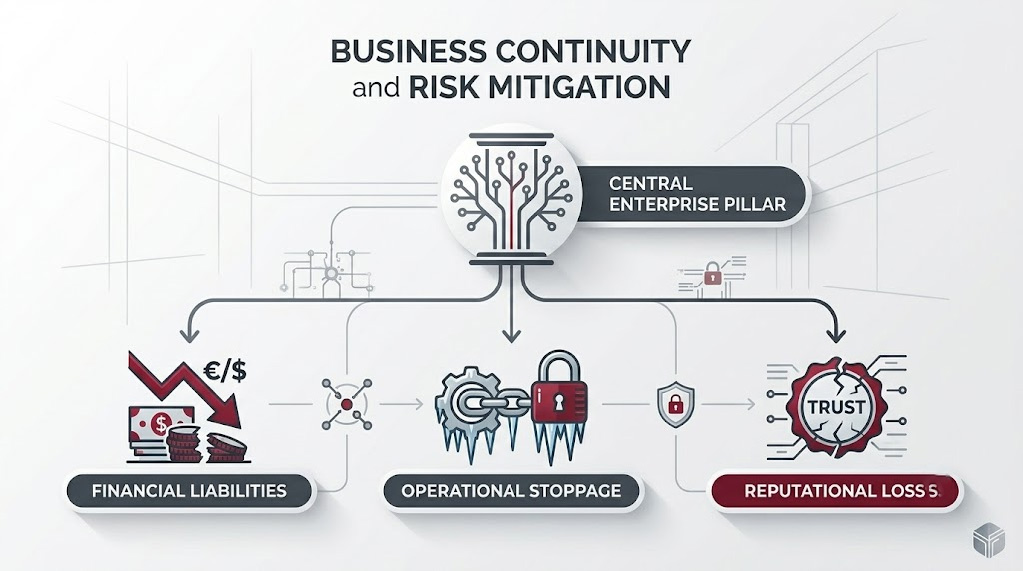
- Financial liabilities: Costs may include forensic investigation, legal counsel, system restoration, customer notification, regulatory response, and public relations.
- Operational disruption: Ransomware, equipment theft, or infrastructure failure can interrupt production, fulfilment, payment processing, and customer service.
- Reputational damage: Customers may reconsider their relationship with a company that cannot protect information or maintain secure facilities.
- Lost business opportunities: Larger customers and public-sector buyers may require evidence of security controls before signing contracts.
- Employee and customer safety risks: Physical security failures can affect people as well as property and information.
The goal of risk management is not to eliminate every possible risk. It is to understand the risks, reduce them to an acceptable level, and prepare a response if an incident occurs.
How Do Physical and Digital Security Systems Compare?
Physical and digital security systems address different attack surfaces, but they should support one another.
| Functional area | Physical security systems | Digital security systems |
| Primary target | Facilities, inventory, equipment, personnel | Cloud services, applications, identities, endpoints, data |
| Core controls | Access control, cameras, monitored alarms, barriers | Firewalls, MFA, EDR, encryption, backups |
| Common threats | Forced entry, theft, vandalism, tailgating | Phishing, ransomware, credential theft, data exfiltration |
| Monitoring model | Video monitoring and central alarm monitoring | Automated logs, security platforms, and SOC analysis |
| Typical failure | Cameras are not reviewed or access is not revoked | Alerts are generated but not investigated |
| Shared objective | Protect people, assets, and operations | Protect information, systems, and operations |
Examples of integration include:
- Using access-control events to improve video investigations.
- Triggering camera verification when an alarm activates.
- Disabling digital accounts and physical badges during employee offboarding.
- Including facility downtime in the cyber incident response plan.
- Protecting server rooms with both physical access control and digital monitoring.
Does My Business Need Cyber Insurance?
Cyber insurance may be appropriate for businesses that process digital payments, store personal information, rely on cloud applications, or depend on internet-connected systems.
A cyber policy may help cover eligible costs related to:
- Legal advice.
- Forensic investigation.
- Data restoration.
- Customer notification.
- Public relations.
- Credit monitoring.
- Business interruption.
- Extortion response.
- Third-party claims.
Coverage varies significantly between insurers and policies. Businesses should not assume that a standard commercial property policy will cover cyber incidents, data loss, or ransomware-related expenses.
Insurers commonly ask about controls such as:
- Multi-factor authentication.
- Endpoint protection or EDR.
- Privileged-access management.
- Tested backups.
- Offline or isolated backup copies.
- Employee security training.
- Incident response plans.
- Vulnerability and patch management.
Businesses that cannot demonstrate these controls may face higher premiums, coverage restrictions, larger deductibles, or difficulty obtaining coverage. Insurance should complement a security program, not replace one.
Protect Your Business Assets with Arann Tech
Arann Tech helps Canadian businesses plan, deploy, and maintain integrated physical and digital security systems.
Our services can support organizations with:
- Commercial access control.
- Business security systems with cameras.
- Monitored business alarm systems.
- Physical security assessments.
- Network and cloud security planning.
- Endpoint and cybersecurity solutions.
- Security infrastructure maintenance.
Contact Arann Tech to schedule a combined physical and digital security assessment.
Schedule Your Security Assessment
Frequently Asked Questions
What are the main types of security systems for business use?
Most businesses use a combination of commercial access control, monitored intrusion alarms, and IP business security camera systems. Digital controls may include firewalls, endpoint protection, multi-factor authentication, email security, backups, and cloud monitoring.
Why is a security business licence required for some security providers?
Security licensing requirements vary across Canada. Depending on the province and service, a provider may need authorization for alarm installation, monitoring, guard services, investigative work, electrical contracting, or other regulated activities.
Businesses should confirm the requirements in their province and request proof of applicable licences, insurance, technician qualifications, and relevant certifications before hiring an integrator.
How does cybersecurity for small business differ from enterprise security?
Small businesses often use consolidated platforms and managed services to reduce complexity and staffing requirements. Larger organizations may operate segmented networks, dedicated identity systems, in-house security operations centres, and formal compliance programs.
The underlying principles are similar, but the scale, staffing, reporting, and customization are different.
Is a standard business alarm system enough for cyber insurance?
No. A physical alarm system protects facilities against unauthorized entry and certain environmental events. Cyber insurance applications generally require evidence of digital controls such as multi-factor authentication, tested backups, endpoint monitoring, patch management, and employee training.
How often should a business security plan be updated?
Review the plan at least once a year and whenever the business experiences a major change. A formal update may be necessary after:
- Moving to a new facility.
- Adopting a major cloud platform.
- Acquiring another company.
- Expanding remote work.
- Hiring new types of contractors.
- Changing payment or data-processing systems.
- Experiencing a security incident.
- Adding a new production or retail location.
What should a business do first when creating a security plan?
Start with an asset inventory and risk assessment. Identify the facilities, systems, data, people, and processes that are most important to the business. Then prioritize the controls that address the highest-impact risks.
Can physical security and cybersecurity be managed in the same plan?
Yes. A unified plan should document both physical and digital controls, along with shared processes such as employee onboarding, offboarding, incident response, vendor management, and business continuity.
What is the most practical security approach for a small business?
Small businesses should prioritize foundational controls before purchasing advanced tools. These typically include multi-factor authentication, secure backups, patch management, endpoint protection, employee training, access control, monitored alarms, camera coverage, and a documented incident response plan.
The most effective security planning process is one that the business can maintain, test, and improve over time.